Current Events — Starter Kit

Imagem gerada por IA.
Keeping up with global events often feels harder than it should. The core challenge isn't a scarcity of information, but the opposite: high-volume inputs across multiple layers make it easy to lose strategic context.
Over time, I realized the problem wasn't the content itself — it was the rhythm. Information moves rapidly, overlaps, and disappears. Forcing this dynamic flow into rigid folder hierarchies (by year, country, or project) causes note systems to break down.
The Current Events framework addresses this by establishing structured review rhythms: capturing facts concisely when they occur and revisiting them in regular cycles so patterns emerge naturally.
Rather than imposing artificial order, the process creates space for clarity through fixed review intervals:
- Weekly: Isolate operational noise and assess immediate shifts (Current Events - Weekly Review - 2026-W06).
- Monthly: Observe broader structural movements (Current Events - Monthly Review - 2026-02).
- Quarterly: Identify emerging macro trends (Current Events - Quarterly Review - 2026-Q1).
- Annually: Consolidate long-term strategic changes (Current Events - Yearly Review - 2026).
Each event is captured as a brief, standardized note recording essential facts, context, and potential impact. Using a consistent layout creates comparability across disparate events, making underlying patterns visible over time.
Instead of hierarchical folder trees, organization relies on links. Events connect directly to topics, entities, or broader narratives — such as a country (Country name), theme (Theme), person (Person), or market sector (Financial Sector, Technology, Security) — building a dynamic knowledge network via backlinks.
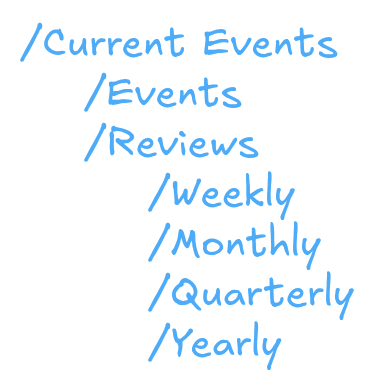
Folder structure
The directory footprint remains minimal. Folders serve strictly as baseline containers while inter-note links handle relationships. Maintaining a separate folder tree for current events establishes a mental boundary between operational tracking and personal knowledge management.
Essential templates
Below are the core templates for each stage of the process.
Event
# Current Event – [[<% tp.date.now("YYYY-MM-DD") %>]]

## Summary
What happened in a few lines. Straight facts.

## Source
Where the information came from (include links if available).

## Key Details
- Essential points.
- Numbers, dates, actors.
- Decisions or relevant changes.

## Context
What led to the event. Previous situation, trends, or external pressures.

## Impact
Immediate consequences. Effects on sectors, people, processes, or markets.

## Analysis
Your interpretation. Relations with other events, risks, opportunities, or hypotheses.

## Contrarian View
What if the consensus is wrong? What is the non-obvious risk here?

## Links
Connections to themes, countries, years, or stories.
Weekly review
# Weekly Review – Current Events – [[<% tp.date.now("gggg-[W]ww") %>]]

## Main Events
Most relevant events of the week.

## What Changed
Perceived changes and shifts.

## Sector Impact
Possible impacts on your specific sector.

## Internal Impact
Internal effects and consequences.

## Points to Monitor
What to watch in the coming days.

## Fire Drills vs. Trends
Which events require immediate resources vs. long-term attention?

## Links
Relevant connections.
Monthly review
# Monthly Review – Current Events – [[<% tp.date.now("YYYY-MM") %>]]

## Executive Summary
2–3 sentences: “What is the threat, what is our exposure, and what are we doing?”

## Structural Movements
Broad movements observed during the month.

## Consolidated Risks
Risks that grew or emerged.

## Opportunities
Identified opportunities.

## Internal Implications
Internal impacts and requirements.

## Board Brief
Summary prepared for status reports (copy & paste ready).

## Links
Connections to notes from the period.
Quarterly review
# Quarterly Current Events – [[<% tp.date.now("YYYY-[Q]Q") %>]]

## Executive Summary
Strategic overview of threats, exposure, and actions.

## Consolidated Trends
Trends confirmed over the quarter.

## Sector Shifts
Major changes in the sector landscape.

## Risk Evolution
How risks have evolved over time.

## Strategic Implications
Long-term effects on strategy.

## Priorities for Next Quarter
Key focus areas for the upcoming months.

## Financial & Budgetary Impact
Does the evolution of these risks require a shift in CAPEX/OPEX?

## Links
Relevant connections.
Annual review
# Yearly Current Events – [[<% tp.date.now("YYYY") %>]]

## Structural Overview
Structural movements that defined the year.

## Sector Evolution
How the sector changed over twelve months.

## Risk Landscape
The overall evolution of the risk environment.

## Opportunities and Lessons
Lessons learned and future opportunities.

## Strategic Direction
Possible directions for the coming year.

## Links
Connections to syntheses and planning.
Current Full Template for Events Capture
While these templates provide the structure, The Executive Pulse series provides the strategy.
To transform daily captures into boardroom alignment and capital allocation, follow the series: The Executive Pulse Series.
Workflow Summary
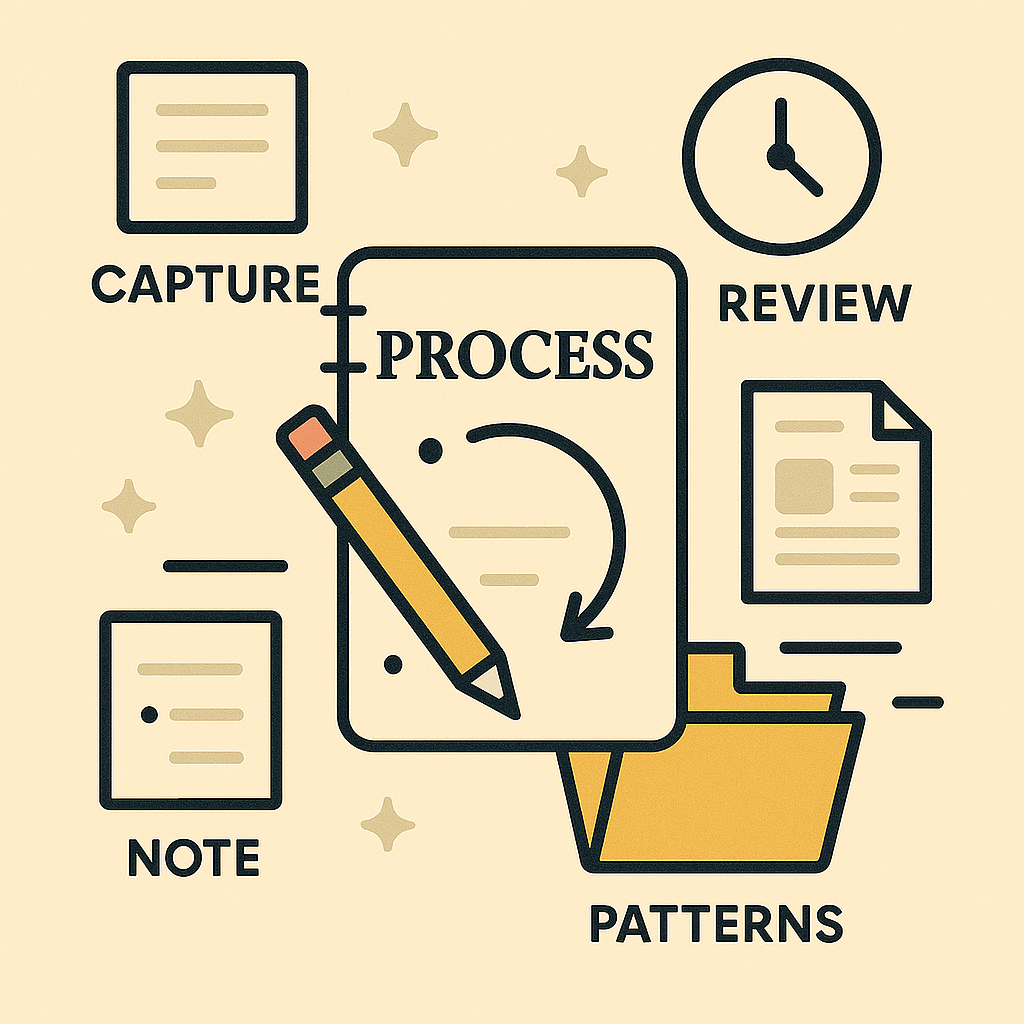
Imagem gerada por IA.
- Daily Capture: Log atomic facts consistently using the standard Event template.
- Weekly Review: Filter operational noise, identify emerging signals, and separate temporary fire drills from trends.
- Monthly Review: Aggregate weekly signals into structural movements and draft executive board briefs.
- Quarterly Review: Evaluate long-term trends and adjust CAPEX/OPEX priorities based on risk evolution.
- Annual Review: Audit strategic intuition and calibrate multi-year goals against historical outcomes.