Idea Compass
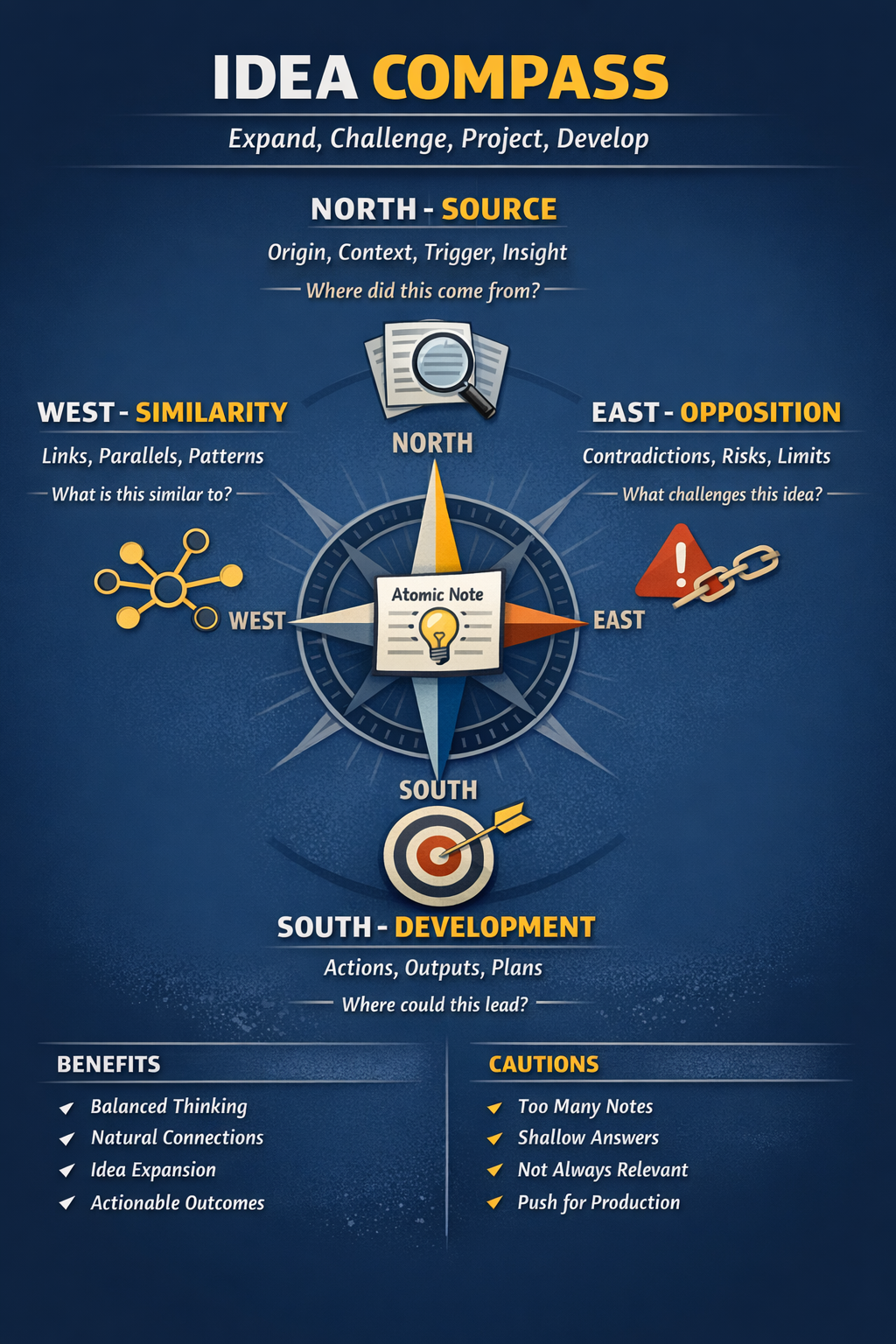
Imagem gerada por IA.
The Idea Compass was created by Vicky Zhao and Fei-Ling Tseng. It forces four thinking movements applied to an atomic note (though it can also be applied to non-atomic notes). Each direction expands, challenges, or projects the original idea. The goal is to turn an isolated note into a connected, useful, and actionable thinking nucleus. It is better used together with Semantic Linking.
Structure of the Four Directions
North — Source
Identify where the idea came from. This includes context, author, event, trigger, observed problem, or situation that generated the insight. Its function is to anchor the note and avoid loose abstractions.
West — Similarity
Look for parallels. Which concepts, patterns, cases, frameworks, notes, or experiences align with this idea? Its function is to build density and natural connections in the graph, providing supporting notes and arguments to the concept being assessed.
East — Opposition
Search for tensions. What contradicts, limits, challenges, or invalidates the idea? What are the exceptions, risks, failures, biases, or scenarios where it does not work? Its function is to balance thinking, challenge assumptions, and avoid fragile conclusions.
South — Development
Project consequences. Which actions, hypotheses, products, decisions, analyses, frameworks, or deliverables can emerge from this idea? Its function is to transform abstract thinking into practical utility by outlining derivative concepts and outcomes.
How to Use It
- Capture an atomic note.
- Apply the four directions sequentially (North, West, East, South).
- Record each answer as a new note or a block inside the original note, as long as atomicity is preserved.
- Create bidirectional links between the original note and the expansions.
- Repeat the process when any expansion deserves deeper exploration.
- Use the resulting cluster as a foundation for writing, decision-making, analysis, or modeling.
Usage Criteria
- Apply it when an idea has clear potential to generate connections, tension, or action.
- Avoid applying it to trivial notes.
- Apply it when transforming an observation into something operational.
- Apply it when testing the robustness of a concept.
- Apply it when preparing ground for writing, frameworks, or strategic decisions.
Advantages
- Ensures structured expansion even when unsure how to proceed.
- Provides cognitive balance between context, parallels, tensions, and consequences.
- Generates natural links and topic clusters.
- Prepares material directly for writing, analysis, and decision-making.
- Applies seamlessly across domains, including consulting, risk, governance, and architecture.
- Trains critical thinking and prevents isolated notes.
Problems and Limitations
- Can inflate the volume of notes if used without clear criteria.
- Risks generating superficial answers if each direction is not explored thoroughly.
- Not every note requires or deserves a compass.
- Can create artificial pressure to produce derivative output from every idea.
- Does not replace deep analysis; it only illuminates potential pathways.